If you have been injured in a motorcycle accident, it is important to seek legal representation. Dealing with the consequences of a motorcycle accident or car collision can be overwhelmingly complex, and a motorcycle accident is a serious legal matter that may involve complex insurance and compensation issues. Personal injury attorneys are crucial in managing these challenges, especially when dealing with serious injuries that may have enduring effects on one’s life. Firms specializing in personal injury law, such as William Rawlings & Associates, excel at steering victims through the complexities of legal proceedings and fighting for rightful compensation for all types of personal injuries, including those from vehicle mishaps.
Embarking on this journey typically begins with a free consultation, where St George, Utah-based injury lawyers will assess your situation and outline an optimal strategy for advancing your claim. Most personal injury law firms offer this no-cost, risk-free initial meeting to discuss your legal matter and determine the best course of action. Many clients who have worked with firms like Truman & Radford and Swenson & Shelley affirm that enlisting a competent advocate, akin to a George personal injury lawyer, is essential in achieving just remuneration. The key is partnering with a proficient law firm acquainted with both motorcycle accidents and general facets of injury law—like Palmer Litigation, which boasts profound experience as George-based attorneys capable of successfully resolving myriad cases specific to this domain—and has garnered recognition among peer George personal attorney circles for their commitment to excellence within the field.
When it comes to wrongful death claims, these may be brought on behalf of the person who was killed in the crash, ensuring that their loved ones can seek justice and compensation.
As we park our discussion on Utah’s helmet laws and motorcycle safety, it’s clear that knowledge is as crucial as any protective gear. From age-specific helmet mandates to the protective armor beyond the helmet, understanding these regulations can steer you clear of legal troubles and, more importantly, keep you safer on the road.
Whether you’re maneuvering through insurance claims, seeking fair compensation, or simply trying to enjoy Utah’s breathtaking rides, staying informed is your best defense. Let this guide be your road map to legal compliance and personal safety. Ride with the confidence that comes from making informed choices, and always remember that the road to safety starts with you.
Frequently Asked Questions
What age group is required to wear helmets while motorcycling in Utah?
Should you be younger than 21 and find yourself on a motorcycle in Utah, wearing a helmet that meets DOT standards is imperative.
Your safety is paramount, so take care while on the road!
Does not wearing a helmet affect the outcome of personal injury claims in Utah?
In Utah, the failure to wear a helmet could be considered contributory negligence and may influence the outcome of compensation awards in personal injury claims.
It is essential to make safety a top concern while riding.
Are there any exceptions to Utah’s helmet law for riders over 21?
If you’re 21 or older in Utah, you don’t have to wear a helmet while riding.
Can non-compliance with helmet laws result in fines in Utah?
Indeed, failure to wear a helmet while required can result in penalties reaching $750 in Utah.
Adherence to helmet regulations is advisable to steer clear of such fines.
What other types of protective gear are recommended for motorcycle riders?
Motorcycle riders are advised to enhance their safety by wearing armor in their jackets, gloves, and boots. This gear helps lessen the likelihood of sustaining road rash or other injuries during rides.
Keep yourself safeguarded on your journeys!
If you’re riding a motorcycle in Utah, do you need a helmet? Utah motorcycle laws mandate that all motorcyclists and passengers under 21 years old wear DOT-approved helmets. The law applies to motorcycles and other motor vehicles that are not fully enclosed, such as autocycles without a fully enclosed cab. For those 21 and over, helmets are optional, but the decision weighs heavily on safety considerations. This article breaks down the Utah helmet law, examining age requirements, exceptions, safety impacts, and other legal nuances riders should know.
- Utah law requires all motorcycle riders and passengers under 21 to wear DOT-approved helmets, with optional use for those 21 and over, despite the raised age limit from 18 to 21 since 2017. The Utah Department of Public Safety oversees helmet regulations and licensing for riders.
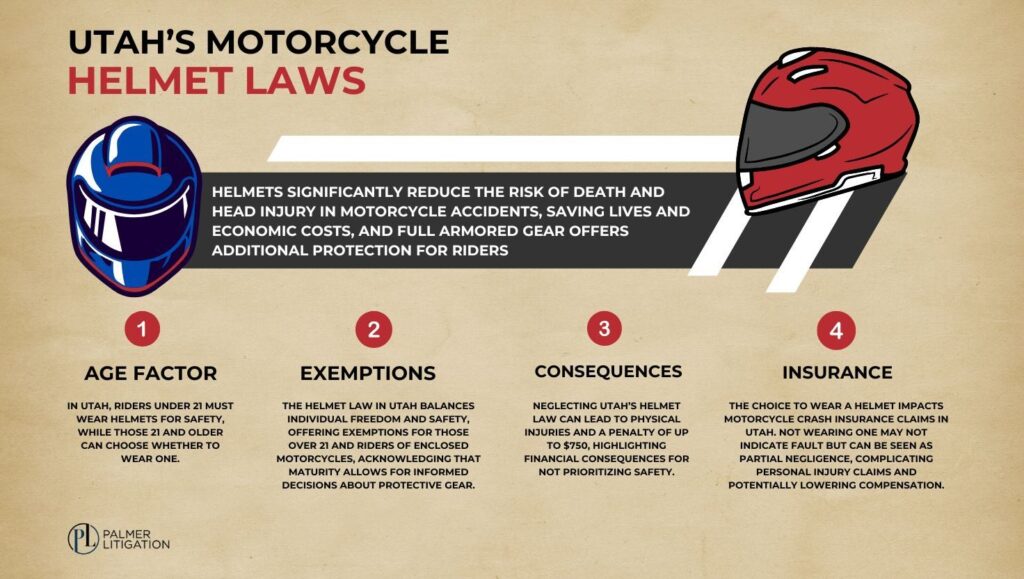
- Helmets significantly reduce the risk of death and head injury in motorcycle accidents, saving lives and economic costs, and full armored gear offers additional protection for riders.
- Non-compliance with helmet laws can result in fines, and riding without a helmet may impact insurance claims and personal injury compensation, underscoring the benefits of legal assistance from personal injury lawyers. Violations of the helmet law for riders under 21 are considered infractions under Utah motorcycle laws.
Introduction to Helmet Regulations
Helmet regulations are a cornerstone of motorcycle safety on Utah roads, designed to protect both motorcycle operators and passengers from the devastating consequences of a motorcycle crash. Utah’s motorcycle helmet laws require all riders and passengers under the age of 21 to wear protective headgear that meets strict federal safety standards. This legal requirement is rooted in public safety concerns, as wearing a helmet dramatically reduces the risk of traumatic brain injuries and other serious head injuries that can result from motorcycle accidents.
For motorcyclists, understanding and following helmet regulations is not just about complying with the law—it’s about minimizing the risk of severe injuries and fatalities. Protective gear, including abrasion-resistant clothing and gloves, further enhances safety by shielding riders from road rash and other injuries in the event of a crash. By making helmet use a priority, Utah motorcycle riders can significantly lower their chances of suffering life-altering injuries, while also setting a positive example for others on the road. Whether you’re a seasoned rider or a new passenger, staying informed about helmet laws and consistently wearing protective headgear is one of the most effective ways to safeguard your well-being and contribute to safer Utah roads.
Navigating Utah’s Helmet Regulations
If you’re considering hopping on a motorcycle in Utah and are not yet 21, remember that wearing a helmet is more than prudent—it’s mandatory. The Utah helmet law applies specifically to those who operate or ride as a passenger on motorcycles that are not fully enclosed. Under the partial helmet law of Utah, anyone under 21 who rides or travels as a passenger on a motorcycle must wear helmets conforming to the stringent safety criteria established by the Department of Transportation (DOT).
The rules of the road and helmet regulations are designed to ensure safety for all who operate motorcycles in Utah.
The regulations may appear simple at first glance. Additional details concerning age requirements and potential exemptions—such as for vehicles that are fully enclosed—are worth noting for all young motorcyclists.
The Age Factor in Helmet Requirements
In Utah, turning 21 isn’t just a milestone for celebration but also signifies a transition in your motorcycling journey. Before this age, wearing a helmet is mandatory, reflecting the vulnerability of younger riders and showcasing Utah’s dedication to safeguarding them. After crossing into the realm of those aged 21 or above, it becomes your prerogative whether to wear a helmet while riding.
The age limit defining this passage hasn’t always been set at 21. Back in 2017, legislators decided to raise the minimum age from 18 to promote safety among young adults—a step aimed at extending protection into early adulthood. Still important to keep in mind is that reaching beyond one’s twenty-first year does not eliminate inherent risks associated with riding bareheaded. Danger doesn’t vanish as one celebrates their legal coming-of-age ceremony with birthday cake candles flickering out.
Exemptions and Exceptions to the Rule
The helmet law in Utah may feel like an unwarranted constraint to those older and more careful, particularly for individuals over 21 or those cruising stylishly inside a motorcycle with a fully enclosed cab. The rule’s exemptions strike a compromise between individual liberty and safety concerns, acknowledging that maturity is often accompanied by the sagacity—or at least the ability—to decide on one’s own protective equipment independently.
Riders of motor assisted scooters must also adhere to specific helmet safety standards, similar to those required for bicycles and electric mobility devices.
Specifications for Motorcycle Helmets
When it comes to motorcycle helmets in Utah, not just any helmet will do. The law requires that motorcycle helmets meet or exceed the federal safety standards outlined in 49 CFR 571.218. These standards ensure that helmets provide adequate impact and penetration resistance, as well as proper visibility for riders. To be compliant, helmets must display a label or certification indicating they meet these federal requirements—a crucial detail for any motorcyclist looking to stay both safe and legal.
Beyond legal compliance, choosing the right helmet involves considering factors like fit, comfort, and additional safety features such as face shields and secure chin straps. A well-fitted helmet not only increases comfort during long rides but also maximizes protection in the event of a motorcycle accident. Riders should also look for helmets with advanced features that can further reduce the risk of injury during a motorcycle crash.
If you are involved in a motorcycle accident on Utah roads, the type of helmet you were wearing—and whether it met legal standards—can play a significant role in personal injury claims and compensation. Consulting with a personal injury lawyer experienced in motorcycle crash cases can help you navigate the complexities of seeking compensation for injuries, medical expenses, and damages. Remember, investing in a high-quality, compliant helmet is not just about following the law—it’s a critical step in protecting yourself and your future every time you ride.
The Impact of Helmets on Motorcycle Safety
Headgear for motorcyclists is a critical safety measure, not merely an optional piece of equipment. Due to their vulnerability compared to those inside vehicles, motorcycle riders face higher risks on the road. In the devastating event of a motorcycle accident, the helmet often stands between the rider and disaster. Statistics indicate helmets decrease mortality by 37% among motorcyclists and by an impressive 41% for passengers while also slashing head injury risk by almost 70%.
From a financial perspective, investing in helmets makes perfect sense. Data from as recent as 2017 reveal that proper helmet use has been credited with saving close to 1,900 individuals and averting billions in economic costs due to potential losses from accidents. Helmets may not be able to stop accidents altogether. However, they significantly mitigate brain injuries’ severity, potentially sparing many individuals from enduring lifelong ramifications.
For those who ride motorcycles, equipping oneself with a helmet transcends completing one’s attire—it serves as indispensable protection amidst unforeseen mishaps that can occur rapidly without warning.
Protective Gear Beyond Helmets: A Rider’s Armor
The dialogue on protective equipment extends beyond just helmet use. For the prudent motorcycle enthusiast, armored gear is a crucial barrier against the harsh reality of asphalt. Not only do these reinforced jackets protect vital regions of your body, but they also aid in minimizing road rash and various other injuries. The primary function is to absorb and disseminate the force during impacts, offering an essential layer of safety for riders in the unfortunate occurrence of a motorcycle crash, regardless if they opt for pliable soft armor or more robust hard shell protection.
Armored apparel may be bulkier and slightly warmer than typical street clothes, yet there’s no competition regarding safeguarding oneself. Riders know that unpredictability is part and parcel of life on two wheels. Adding extra defensive measures like stout gloves and sturdy boots could prove invaluable during unforeseen situations. Essentially, gearing up entails preparing for weather conditions and fortifying oneself against potential mishaps.
Consequences of Non-Compliance
Neglecting Utah’s helmet law could result in consequences that extend beyond physical injury in a crash. Violations of the helmet law for riders under 21 are considered infractions, which may result in fines. A penalty of up to $750 may be imposed for non-compliance, indicating that the price for not prioritizing safety can also affect one’s finances.
Individuals over 21 years old face an intriguing circumstance: wearing a helmet when committing a traffic offense might prompt the court to reduce their fine by $8. This reduction is modest but underscores the recognition of maintaining safety measures. Conversely, younger riders under 21 do not receive this benefit, reflecting Utah’s stern stance on protecting its youthful population’s well-being.
How Utah’s Helmet Law Compares to Surrounding States
Utah distinguishes itself with its helmet laws, which are significantly less stringent than those of neighboring states. While Nevada requires helmets for all motorcycle riders without exception and Arizona imposes this requirement on individuals younger than 18, Utah offers greater leeway to individuals over 21. In contrast, New Hampshire is one of the few states without a mandatory helmet law, making it even less restrictive than Utah in this regard.
The state’s more relaxed attitude towards helmet regulations indicates a broader pattern observed in some states that prioritize individual freedom while considering public safety concerns. For motorcyclists traversing various jurisdictions, staying informed about these varying legal requirements is essential to ensure compliance with local laws and personal safety during travel.
Understanding Insurance Implications
Whether or not to wear a helmet is just one of the many issues when discussing an insurance claim following a motorcycle crash. In Utah, all motorcyclists must carry liability insurance to operate their motorcycle on public roads. Insurance coverage is required by law, and liability insurance covers damages to others in the event of a crash. While using a helmet isn’t considered direct evidence of fault, failing to wear one does not automatically establish comparative negligence or contributory or comparative negligence in personal injury lawsuits, but it may be considered by the court and could potentially affect your ability to seek compensation.
As settlement negotiations unfold between injury lawyers, representatives from insurance companies, and their adjusters, particulars such as helmet usage become significant. Accident victims may seek compensation for medical bills, lost wages, and other damages. They weigh medical expenses already incurred, likely future costs for ongoing medical care needed due to injuries sustained in the accident, along with emotional suffering endured. The absence or presence of a helmet doesn’t stop an incident from happening. Still, it may influence how insurers assess your claim—highlighting why it’s crucial to grasp how decisions made while riding impact legal outcomes and interactions with insurance regarding personal injury incidents. Consulting a motorcycle crash attorney can help you understand your rights and seek compensation for medical bills, lost wages, and other damages.
Road Safety Tips for Motorcyclists in Utah
Every motorcyclist in Utah should practice certain safety measures that go above and beyond the legal requirements. It is crucial to make oneself more visible. This can be achieved by carefully choosing your position on the road, wearing gear that stands out, or staying away from areas where you might not be seen easily. Riders should stay alert and look ahead 3 to 4 seconds down the road when navigating bends so they do not get fixated on one spot and thus be better prepared for unforeseen hazards.
Understanding and following the rules of the road is essential for every rider’s safety. In Utah, it’s important to know the difference between lane splitting and lane filtering. Lane splitting—riding a motorcycle between lanes of traffic moving in the same direction at higher speeds—is illegal in Utah. However, lane filtering, which allows motorcycles to move between stopped or slow-moving vehicles traveling in the same direction at low speeds, is permitted under specific conditions. Always be aware of these rules to ensure you are riding legally and safely.
Each season comes with unique challenges for Utah bikers – from encountering wildlife or pets wandering onto roads, dealing with slippery surfaces due to ice formation, or enduring extreme heat. Riding as a group offers its joys, but also requires knowledge of how best to arrange bikes safely while using clear communication signals with other riders. Taking someone along as a passenger brings an extra level of responsibility, necessitating appropriate adaptations so that everyone remains safe throughout the journey.
Legal Support for Motorcycle Accident Victims
If you have been injured in a motorcycle accident, it is important to seek legal representation. Dealing with the consequences of a motorcycle accident or car collision can be overwhelmingly complex, and a motorcycle accident is a serious legal matter that may involve complex insurance and compensation issues. Personal injury attorneys are crucial in managing these challenges, especially when dealing with serious injuries that may have enduring effects on one’s life. Firms specializing in personal injury law, such as William Rawlings & Associates, excel at steering victims through the complexities of legal proceedings and fighting for rightful compensation for all types of personal injuries, including those from vehicle mishaps.
Embarking on this journey typically begins with a free consultation, where St George, Utah-based injury lawyers will assess your situation and outline an optimal strategy for advancing your claim. Most personal injury law firms offer this no-cost, risk-free initial meeting to discuss your legal matter and determine the best course of action. Many clients who have worked with firms like Truman & Radford and Swenson & Shelley affirm that enlisting a competent advocate, akin to a George personal injury lawyer, is essential in achieving just remuneration. The key is partnering with a proficient law firm acquainted with both motorcycle accidents and general facets of injury law—like Palmer Litigation, which boasts profound experience as George-based attorneys capable of successfully resolving myriad cases specific to this domain—and has garnered recognition among peer George personal attorney circles for their commitment to excellence within the field.
When it comes to wrongful death claims, these may be brought on behalf of the person who was killed in the crash, ensuring that their loved ones can seek justice and compensation.
As we park our discussion on Utah’s helmet laws and motorcycle safety, it’s clear that knowledge is as crucial as any protective gear. From age-specific helmet mandates to the protective armor beyond the helmet, understanding these regulations can steer you clear of legal troubles and, more importantly, keep you safer on the road.
Whether you’re maneuvering through insurance claims, seeking fair compensation, or simply trying to enjoy Utah’s breathtaking rides, staying informed is your best defense. Let this guide be your road map to legal compliance and personal safety. Ride with the confidence that comes from making informed choices, and always remember that the road to safety starts with you.
Frequently Asked Questions
What age group is required to wear helmets while motorcycling in Utah?
Should you be younger than 21 and find yourself on a motorcycle in Utah, wearing a helmet that meets DOT standards is imperative.
Your safety is paramount, so take care while on the road!
Does not wearing a helmet affect the outcome of personal injury claims in Utah?
In Utah, the failure to wear a helmet could be considered contributory negligence and may influence the outcome of compensation awards in personal injury claims.
It is essential to make safety a top concern while riding.
Are there any exceptions to Utah’s helmet law for riders over 21?
If you’re 21 or older in Utah, you don’t have to wear a helmet while riding.
Can non-compliance with helmet laws result in fines in Utah?
Indeed, failure to wear a helmet while required can result in penalties reaching $750 in Utah.
Adherence to helmet regulations is advisable to steer clear of such fines.
What other types of protective gear are recommended for motorcycle riders?
Motorcycle riders are advised to enhance their safety by wearing armor in their jackets, gloves, and boots. This gear helps lessen the likelihood of sustaining road rash or other injuries during rides.
Keep yourself safeguarded on your journeys!